There are no items in your cart
Add More
Add More
| Item Details | Price | ||
|---|---|---|---|

The moment you decide to pursue your investment advisor certification seriously, you're not just picking an exam to clear. You're deciding what kind of adviser you want to be in a market where AI can already screen thousands of funds, flag portfolio risks, and draft reports faster than any human can type.
The real question isn't "should I clear NISM X-A and X-B." It's "what kind of adviser do I want to be for the families who will trust me with their money, at a time when algorithms are everywhere but trust is still rare."
In India, most people don't walk up to a robo-advisor screen and pour out their life savings plan. They sit across a table, sometimes literally over chai, with someone their family has known, or someone a relative vouched for. They want that person to understand:
That's the job. No amount of AI changes what a client actually needs from you as a person.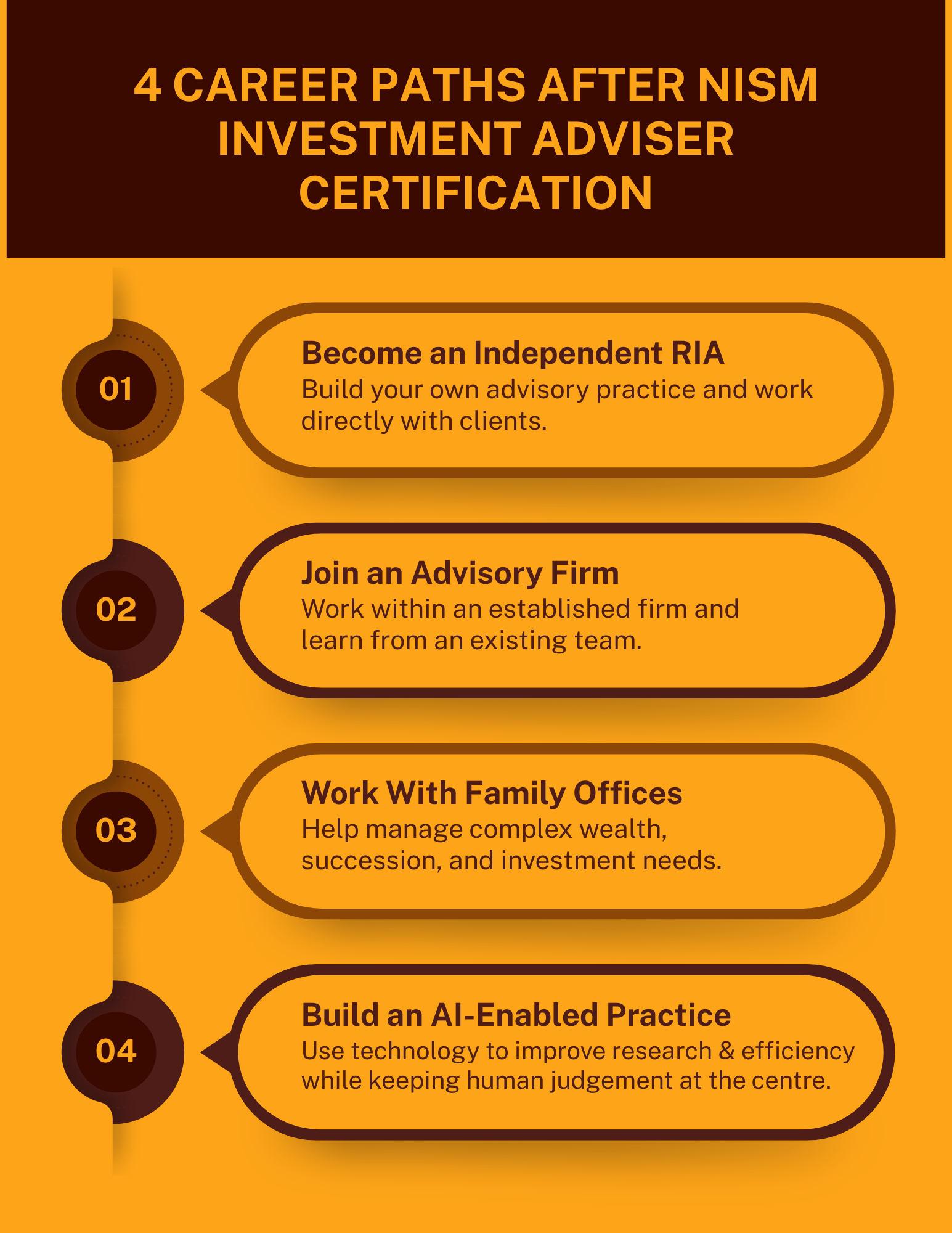
Clearing the certification exam and registering with SEBI puts you in the same regulated bucket as every other adviser on paper. What happens next looks completely different depending on how comfortable you are with technology, how much ownership you want over your practice, and where you choose to work.
Broadly, three paths are opening up for certified advisers in India right now:
The differentiator isn't the certificate itself, it's how willing you are to carry fiduciary responsibility while the tools around you keep changing.
Readers curious about the family office route can go deeper in our piece on how family offices in India are growing and what they expect from certified advisers.
On paper, the Level 1 exam looks straightforward. Here's what it involves:
If you only see this as an exam to clear, AI feels like something you'll deal with later. But if you see it as training ground for advising in an AI-rich world, the same syllabus starts looking very different. The curriculum covers:
These are exactly the areas where AI tools are already active in budgeting apps, robo-advisors, factor-investing platforms, portfolio analytics dashboards, and compliance screening engines. The exam is your chance to learn how to think alongside these tools, not just without them.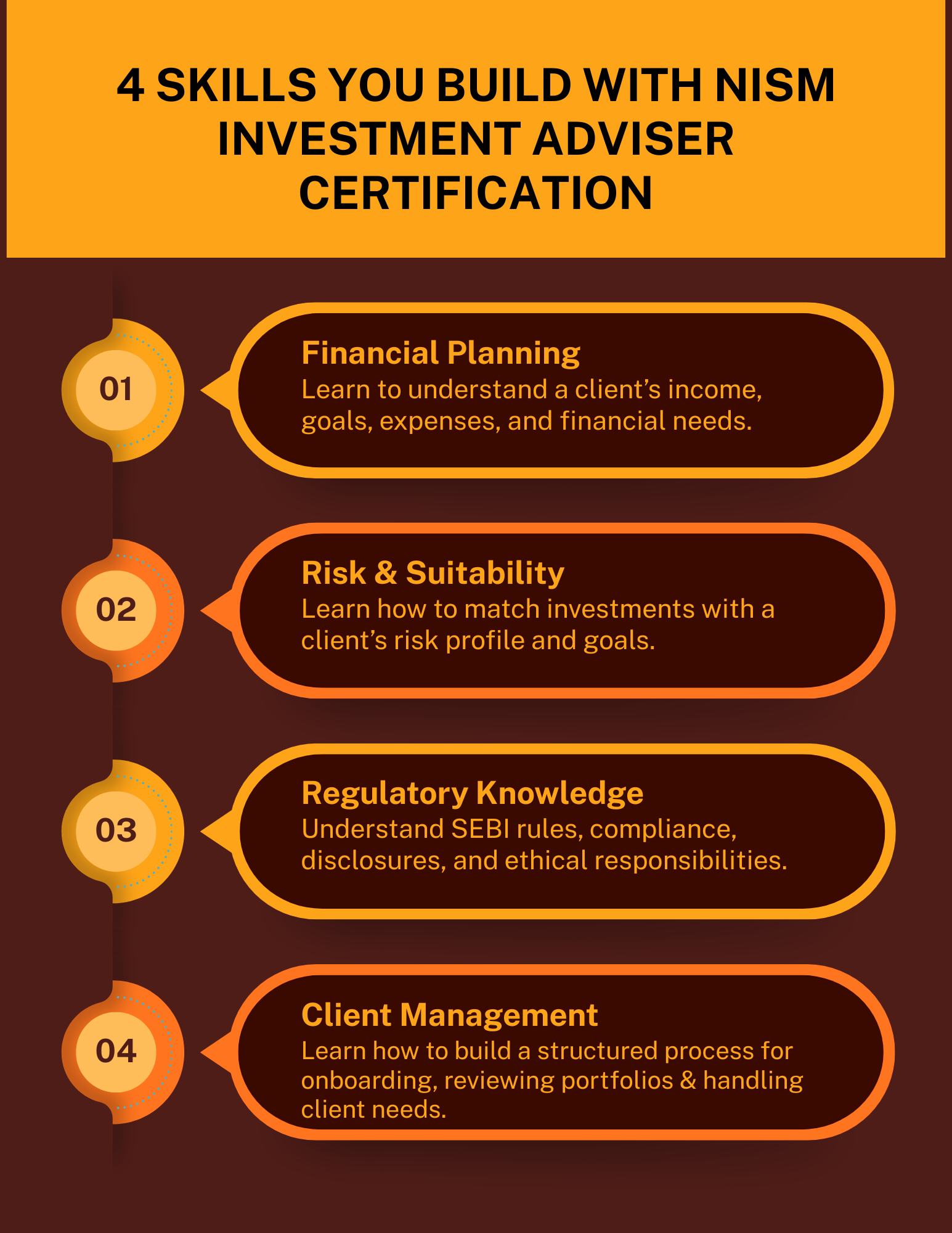
Strip away the jargon, and this certification teaches four skills AI cannot replace, even as it keeps getting smarter.
AI can crunch numbers from bank statements or trading logs in seconds. It can't decide on its own which parts actually matter for someone's life. Through the personal financial planning modules, you learn to:
When you eventually bring AI tools into your practice, you're still the one deciding what the data means, not the model.
AI is excellent at back-testing and past performance analysis. Suitability is still a human call. The syllabus makes you absorb suitability rules, risk profiling, and SEBI's expectations around documented reasoning. These are the same things regulators and clients lean on when something goes wrong, not a model's confidence score.
A large chunk of the syllabus goes into SEBI's Investment Advisers Regulations, IAASB processes, and ethics. You learn how advice is legally separated from distribution, how fee caps and disclosure norms work, and how registration, inspection, and supervision actually function.
This matters because SEBI's own communication style is unpredictable: a short notice today, a full circular weeks later. A SEBI-registered adviser who stays close to these updates can act early, while an AI tool can only be trained on rules after they're published.
In 2025, SEBI's master circular and FAQs reinforced that principal officers and persons giving investment advice must meet certification and qualification norms, and that every step of the advice process needs to be documented and auditable.
If you want the registration steps laid out clearly, our NISM registration process guide turns the regulation into a practical checklist.
Perhaps the most underrated part of the syllabus is process design. It quietly teaches you to:
AI can make each of these steps faster. It cannot set the ethical tone of your practice. That's your job, and this exam is quietly training you for exactly that.
The path after you clear this certification is where AI either becomes your best ally, or just another excuse to procrastinate on building real skill.
If you're weighing this certification against other credentials like CFP, our piece on why you might consider NISM Series X before CFP walks through a plain, non-promotional comparison for Indian candidates who want to work as regulated advisers first.
It's easy to picture AI as some sci-fi layer sitting on top of finance. The reality inside Indian wealth management is far more grounded, and honestly, still catching up.
A lot of AI advisory tools exist on paper across various fintech platforms, but adoption in India isn't as smooth as it looks in pitch decks. Most Indians still want to sit with a person who understands their income, their family situation, their business, and their long-term worries, not just type queries into a chatbot. Younger investors, who've just started out, are usually the ones experimenting with AI-led robo-advisory tools. Parents and senior decision-makers in the family, who are usually the ones actually steering money decisions, still lean toward registering with a human RIA. The reason is simple: trust. A client wants to know that whenever they have a question, they can reach their adviser and get a real answer, not a generic response from a model.
Coverage through 2024 and 2025 shows AI quietly doing real work behind the scenes in Indian family offices and RIA practices:
For a certified adviser, this means learning to walk a client through an AI-generated report without letting the tool override suitability, and being confident enough to say the model likes this trade, but given your family's liquidity needs and governance structure, we will not follow it fully.
Readers who want real examples of how this plays out can read our detailed piece on family offices in India and what they expect from NISM-certified advisers.
It helps to see clearly what separates advisers who thrive alongside AI from those who struggle with it.
The good news, especially if you're just starting to explore this field, is that most of these traits can be deliberately built. A structured syllabus and serious mock-test based preparation nudge you in this direction even if you're a complete beginner today.
Before signing up for this certification, sit with two honest questions:
If both feel like a yes, pairing this certification with an AI-aware mindset is a strong bet for the next decade of Indian finance.
 Launch your Graphy