There are no items in your cart
Add More
Add More
| Item Details | Price | ||
|---|---|---|---|

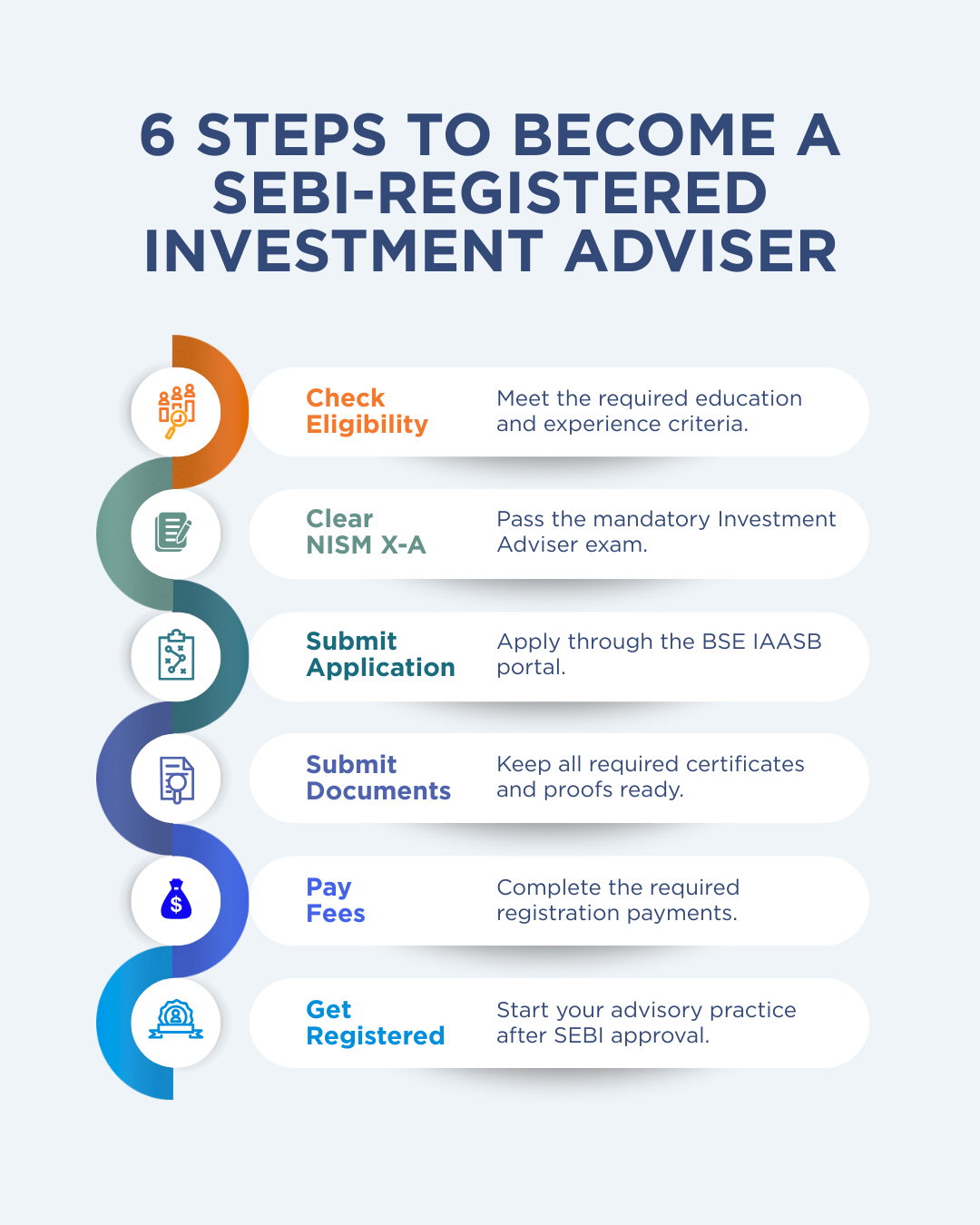
Becoming a SEBI-registered NISM investment advisor in 2026 runs through six stages: check eligibility, clear NISM X-A, register on BSE's IAASB portal, submit documents, pay fees, and maintain a client-linked deposit before your certificate is issued. The old net-worth requirement is gone, replaced by a refundable deposit under lien that scales with your client count. This guide walks through every step using the current fee structure, deposit slabs, and the newer part-time adviser route, plus what to expect once you move on to NISM investment advisor level 2.
Anyone who wants to charge a fee for personalised investment advice in India, rather than earning commission through product sales, needs to register as an investment adviser with SEBI. This is different from a mutual fund distributor, whose income comes from trail commission and doesn't require the same registration.
The distinction matters because SEBI's framework imposes a fiduciary duty on registered advisers. You must act in the client's interest, avoid conflicts, and keep advice separate from distribution. Whether you're switching from a distribution model to fee-only advice, or starting fresh, this registration is the mandatory gateway, and it begins with a NISM investment advisor certification.

SEBI's framework, updated through its December 2024 amendment, eased several older entry barriers.
Once these are met, the certification stage begins.
NISM Series X-A, Investment Adviser Level 1, is the certification SEBI requires before you can apply for registration. There's no prescribed minimum qualification to sit for the exam itself, though your educational background is separately checked during registration.
You book the exam through NISM's certification portal, choose a test centre and slot, and get your result immediately.
Clearing X-A alone is enough to begin the SEBI registration process described in the steps below. But most advisers eventually also need NISM Investment Advisor Level 2 (X-B), which SEBI requires for anyone providing advice at a more advanced level, particularly principal officers of non-individual advisers. X-B builds on X-A with applied caselets on portfolio construction and taxation, six caselets of five questions each plus ninety standalone MCQs, under the same 60% passing threshold and negative marking structure.
Because Level 2's caselets test applied judgement rather than recall, a NISM Investment Advisor Level 2 mock test regimen that simulates caselet conditions, not just standalone MCQ drilling, tends to separate first-attempt clears from repeat attempts.
SEBI appointed BSE Limited as the Investment Adviser Administration and Supervisory Body, or IAASB, for a five-year term starting July 25, 2024. Every registration application now flows through BSE's dedicated portal rather than going directly to SEBI. To begin:
This is the first formal checkpoint in the chain, where BSE starts collecting your basic details before the deeper documentation stage.
After your BSE IAASB login is active, you'll land on a dashboard split across several tabs: personal information, educational qualifications, certification proof, and compliance declarations.
Once every tab is complete and documents are uploaded, the application goes through a verification cycle. If BSE flags anything unclear, you'll need to correct it before moving to the fee stage.
Registration involves two separate fee streams: what goes to SEBI directly, and what goes to BSE as the administering IAASB. These are separate from your original NISM exam fees, which typically fall between ₹1,200 and a few thousand rupees per attempt.
These figures exclude applicable taxes and sit separately from the deposit requirement covered next. The SEBI application fee is typically paid through the SEBI Intermediary Portal, while the BSE administrative fee is paid as part of IAASB enlistment.
This is the part of the process that changed most in the last two years. SEBI's December 2024 amendment removed the old net-worth requirement and replaced it with a deposit held under lien in favour of IAASB.
The deposit slabs, based on the maximum number of clients served in the previous financial year, look like this:
A few things worth understanding about how this deposit actually works:
This distinction, deposit versus fee, is where most first-time applicants get confused, and it materially changes how much actual money you're spending versus setting aside as security.
Once BSE IAASB verifies your application, documents, and deposit compliance, it recommends your file to SEBI for final approval. SEBI then reviews the recommendation and, if satisfied, issues the Certificate of Registration.
Processing timelines vary, but applicants commonly report a window of two to six months from submission to certificate issuance, depending on how quickly queries get resolved and how complete the original application was. Once certified, you can begin offering investment advisory services under your own registration, subject to ongoing obligations like periodic disclosures and continued adherence to the fiduciary standard.
For an individual applicant, the full upfront picture looks like this:
Body corporates and LLPs pay considerably more across every line, with the BSE administrative fee alone running to ₹5 lakh for a five-year block.
For an individual, the total upfront cash outlay before the deposit works out to roughly ₹15,000 to ₹20,000, with the deposit sitting separately as blocked capital rather than a sunk cost.
SEBI's December 2024 amendment also created a Part-Time Investment Adviser category, aimed at professionals who want to offer advisory services without leaving their primary job.
This track exists specifically for people who want to test advisory work on a smaller scale before deciding whether to go full-time, and it's one of the biggest reasons the barrier to entry has genuinely dropped since 2024.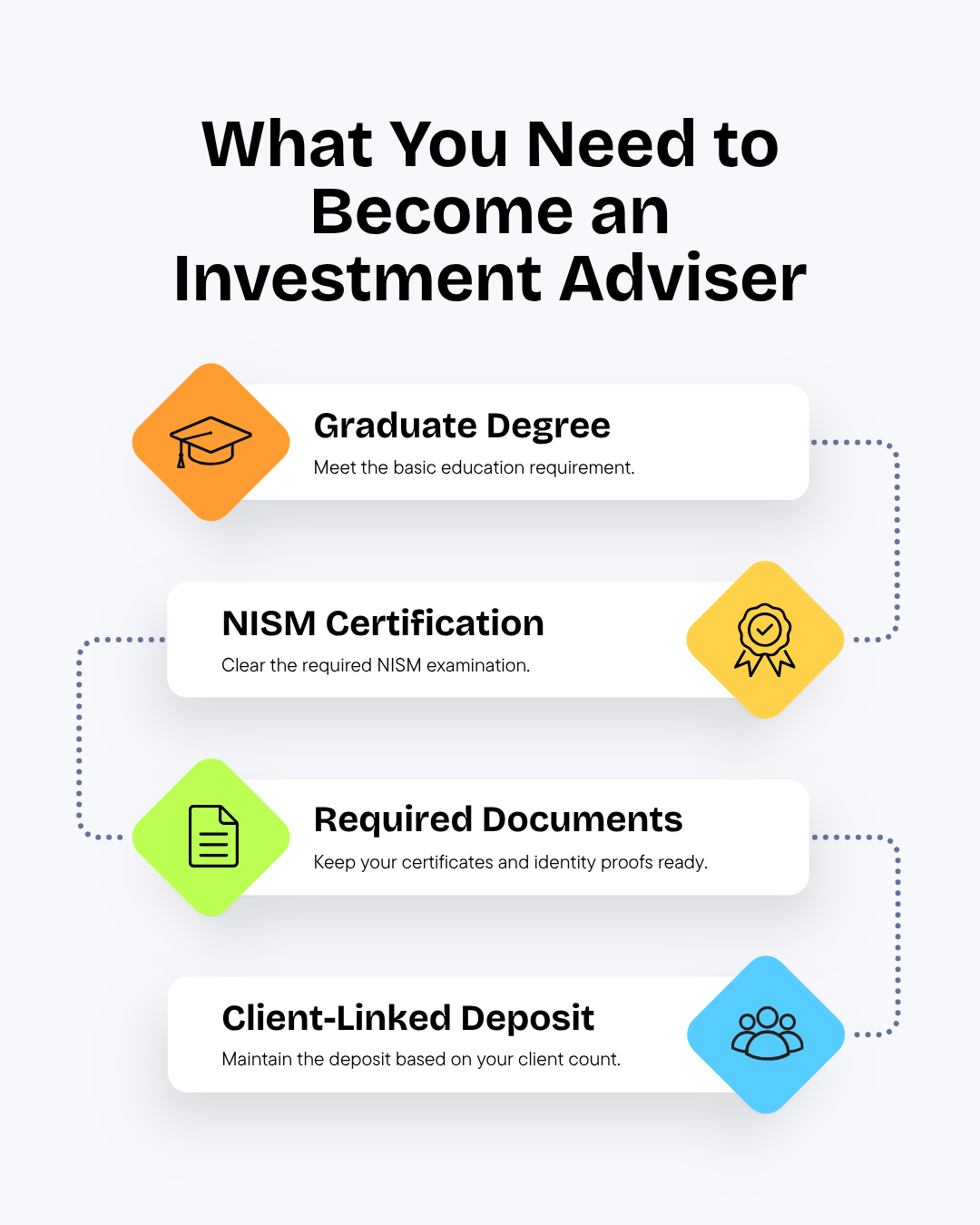
Despite the process being clearer than it was a few years ago, India still has fewer than 1,000 SEBI-registered investment advisers against an investor base of over 20 crore demat accounts. SEBI's own chairman flagged this gap publicly in 2026, pointing out that unregulated influencers are filling the space that qualified advisers should occupy.
Part of the reason is awareness, not difficulty. Family offices in India grew from roughly 45 in 2018 to nearly 300 by 2024, and client demand for advisers who understand governance and succession planning, not just fund selection, is rising faster than the supply of certified professionals. The registration process outlined above is more accessible than most people assume; the gap exists because relatively few candidates walk through it end to end.
A few recurring issues slow down applications on the BSE IAASB portal:
Getting documentation right the first time can shave weeks off the total timeline.

Click here to enrol for FREE into Financial Planning Masterclass: https://www.profsheetalkunderacademy.com/courses/Financial-Planning-Masterclass
What Changed in the SEBI Framework Recently
If you're comparing this guide against older content online, three changes are worth flagging, since a lot of existing material still describes the pre-2024 framework:
If an article you're reading still describes a flat net-worth threshold for individual advisers, it's describing a framework SEBI has already replaced.
A thousand advisers for 20 crore+ investors was never a sign that this path is too hard or too crowded. It's a sign that the door only recently opened wide enough for people outside the old finance-elite mould to walk through it.
If you're weighing whether to start, mapping the X-A and X-B syllabus against realistic caselet-style mock tests before you commit is the single most useful thing you can do early. NISM X-A exam guide
For candidates who clear both levels, FYIAEP extends a job guarantee to those who clear NISM X-A and X-B and hit at least 50% of the Month 4 evaluation target, with no cap on candidates absorbed. It's conditional, tied to those two milestones, not an unconditional promise, but it removes real post-certification uncertainty for anyone entering this gap.

Prof Sheetal Kunder
SEBI® Research Analyst. Registration No. INH000013800 M.Com, M.Phil, B.Ed, PGDFM, Teaching Diploma (in Accounting & Finance) from Cambridge International Examination, UK. Various NISM Certification Holders. Ex-BSE Institute Faculty. 18 years of extensive experience in Accounting & Finance. Faculty Development Programs and Management Development Programs at the PAN India level to create awareness about the emerging trends in the Indian Capital Market, and counsel hundreds of students in career choices in the finance area
Do I need to clear NISM X-A before applying for SEBI investment adviser registration?
Yes. NISM X-A, Investment Adviser Level 1, is a mandatory certification before you can submit your application through the BSE IAASB portal.
What is the validity period of the NISM X-A certificate?
The certificate is valid for three years from your pass date, after which you need to revalidate it to stay compliant.
How much does the NISM investment advisor exam cost?
The exam fee itself typically runs 1,200 to a few thousand rupees per attempt.Separately, SEBI and BSE registration fees add roughly F15,000 for an individual applicant, excluding the refundable deposit.
What is the client-linked deposit and how is it calculated?
It is capital held under line with IAASB, based on your maximum client count in the previous financial year: *1 lakh up to 150 clients, 82 lakh for 151 to 300, 75 lakh for 301 to 1,000, and 710 lakh above that. The slab is reviewed annually by April 30.
Can the deposit be placed in mutual funds instead of a fixed deposit?
Yes. SEBI's August 2025 circular allows the deposit to be held either as a fixed deposit or as units of liquid or overnight mutual funds, subject to lien marking in favour of IAASB.
Who actually processes my registration, SEBI or BSE?
BSE, as the appointed AASB since July 2024, receives and processes applications through its portal. SEBI issues the final Certificate of Registration based on BSE's recommendation.
How long does the full registration process usually take?
Individual applicants commonly see a two-to six-month window from submission to certificate issuance, depending on the completeness of the documents and how quickly queries are resolved.
 Launch your Graphy