There are no items in your cart
Add More
Add More
| Item Details | Price | ||
|---|---|---|---|

Sat May 16, 2026
Taking a NISM 25A mock test before the real exam is not optional, it is preparation. Reading the workbook tells you what is in the syllabus, but a timed mock under real conditions tells you whether you actually know it well enough to pass. Because NISM 25A has no negative marking, mock strategy here works differently from every other NISM exam, and this guide covers exactly how. The next step from this page is to take a free NISM 25A mock test built on the current curriculum and get a chapter-wise performance report showing exactly where you stand before you read any further.
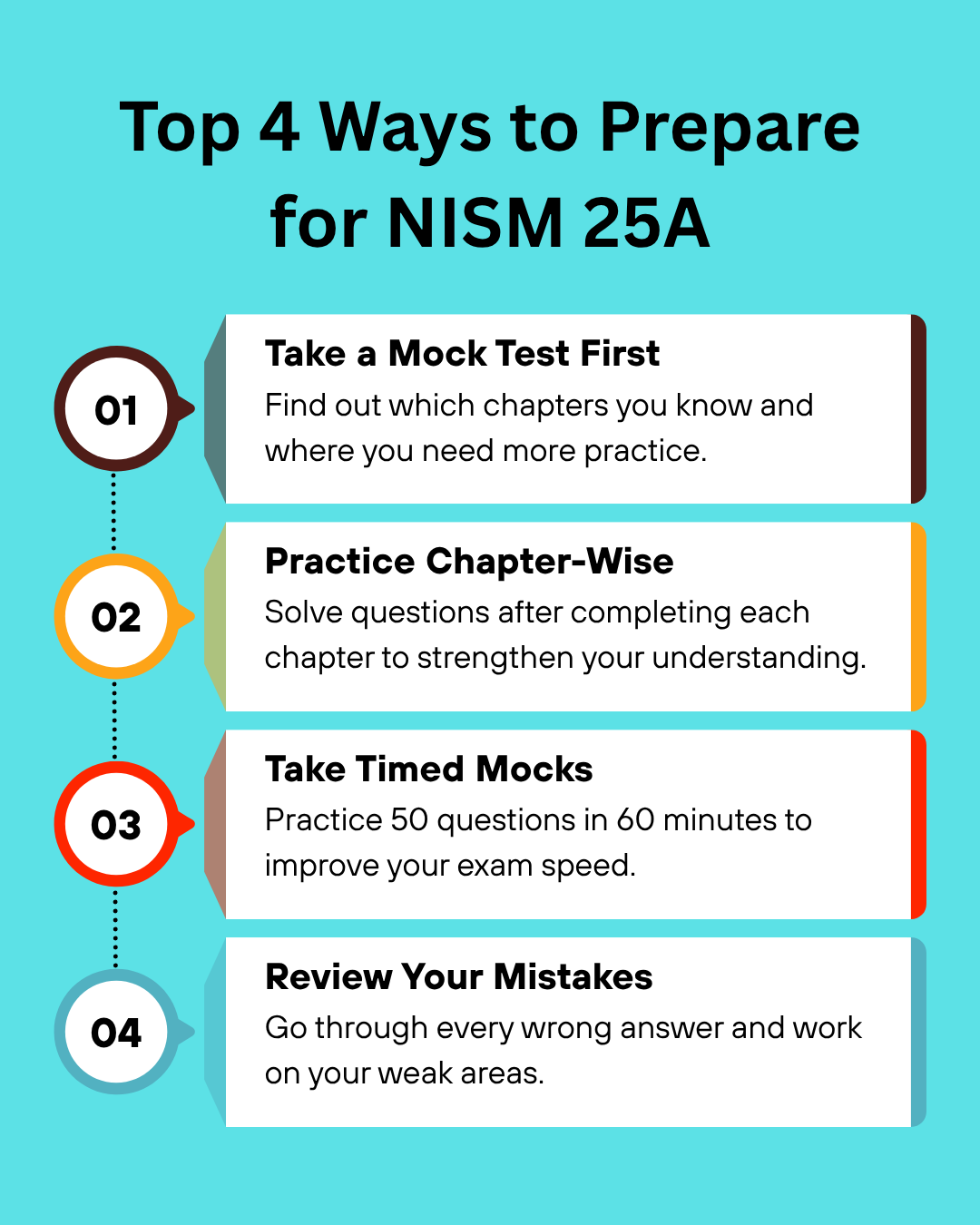
Most candidates underestimate the gap between reading the workbook and being ready to pass. Reading creates familiarity, and familiarity feels like understanding. A timed mock under exam conditions reveals the real gap between the two.
A mock test does three things reading alone cannot do:
There is also a psychological reason mocks matter. Sitting a proctored exam for the first time is stressful even for well-prepared candidates. A webcam watching you, a strict timer, and the knowledge that this attempt counts can cause confident candidates to freeze on easy questions. Doing several mocks under similar conditions trains your nervous system to treat the real exam as routine rather than novel.
If you have cleared NISM Series V-A, Series VIII, Series X-A, or Series 15 before, your old mock strategy needs to change here.
No negative marking changes everything. In exams with negative marking, skipping uncertain questions preserves marks.
NISM 25A has zero negative marking, so there is no skip-or-attempt decision left to manage.
This means:
Format also matters. Mocks should replicate the real exam exactly. A 100-question, 120-minute mock built for a different exam will not prepare you for a 50-question, 60-minute session.
A third difference is how fast feedback arrives. NISM 25A results appear on-screen the moment you submit, with no waiting period. A mock environment with instant scoring and chapter-wise breakdown lets you correct course the same day rather than waiting several days to find out where you stand.
Not every mock circulating online is built on the right curriculum. Check these three things before using any resource.
Curriculum accuracy:
Chapter weightage alignment:
Format alignment:
One more filter worth applying is currency. NISM revises its workbook when SEBI updates regulations, and a mock built on an older curriculum version can quietly test outdated rules. Check whether a mock references the current workbook version before trusting it.
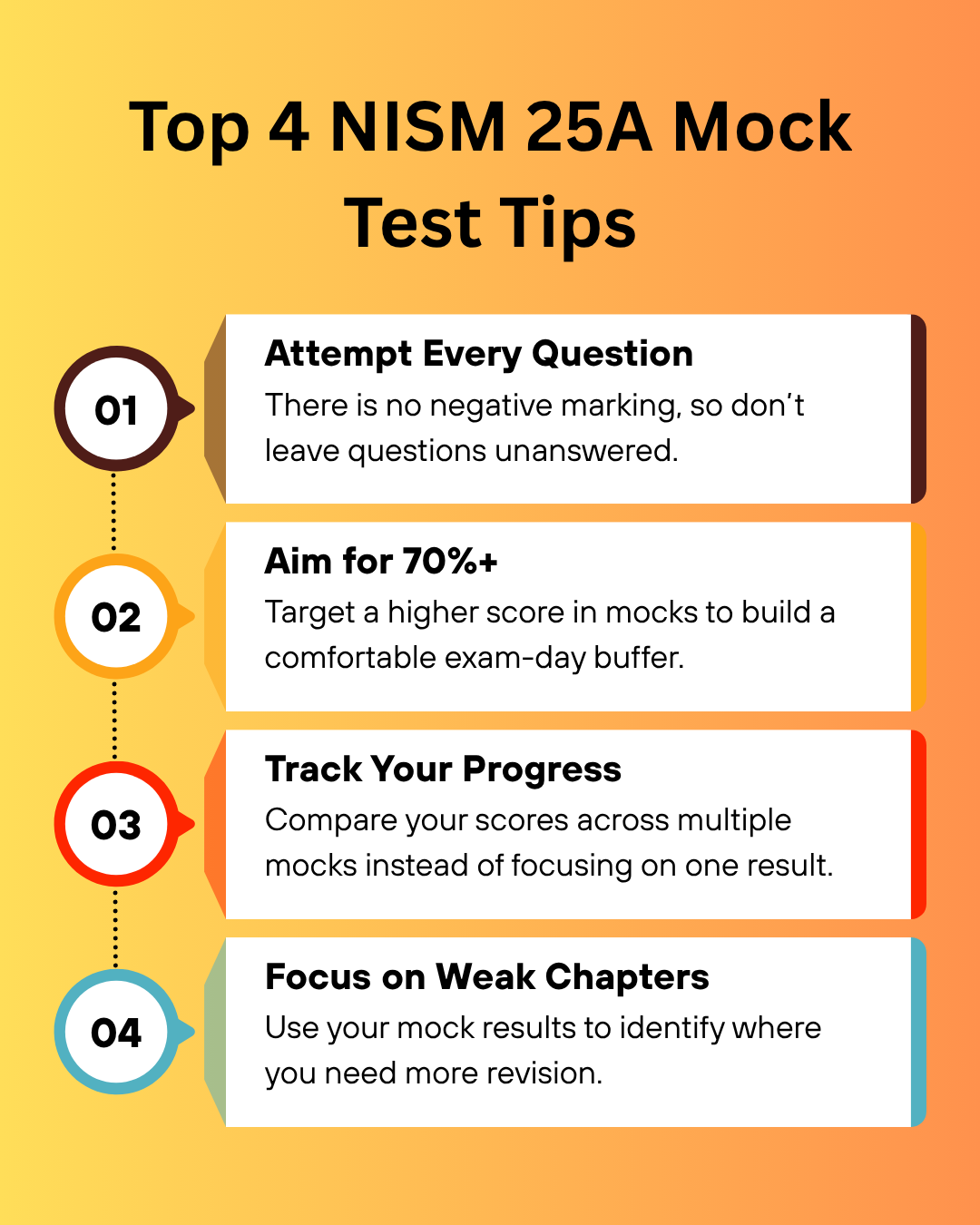
Mock tests work best when built into a plan from the start rather than used only as a last check.
Stage | What to Do |
Week 1 to 2 | Take one diagnostic mock before studying anything, to find familiar and unfamiliar chapters |
Week 3 to 4 | After each workbook chapter, take 15 to 20 chapter-specific questions before moving on |
Week 5 | Take one full 50-question timed mock as a progress check |
Week 6 | Take three to four full mocks under real conditions, targeting 70% or above |
The diagnostic mock in Week 1 usually produces a low score. That discomfort is the point, since it gives you a real baseline to measure progress against.
If your preparation window is shorter, the same structure applies, just compressed. What should not change is the order: diagnose first, practice by chapter next, and take full mocks only once weak areas have already been addressed once.
Because there is no negative marking, NISM 25A mock scores are cleaner signals than most other NISM exams.
Track your guessing pattern, not just your score:
Track your score trend rather than obsessing over any single mock. A single low score after a bad night's sleep does not mean your preparation has failed. What matters is whether your average across three or four consecutive mocks is trending upward.
Different chapters need different practice approaches based on how their questions are structured.
A practical approach is to tag every mock question by chapter as you go, even if the platform doesn't do it automatically. Over several mocks, this builds your own private version of a chapter-wise performance report.
A handful of mistakes show up repeatedly among candidates who need a second attempt.
A less obvious mistake is treating every mock as equally important. Short chapter-specific sets should stay light and frequent. Reserve full, timed, distraction-free conditions specifically for progress-check and final-week mocks.
There is no fixed number that works for everyone, but a reasonable range exists based on your starting point.
More mocks help only if each one is reviewed properly. Ten mocks taken without reviewing wrong answers teach you far less than five mocks reviewed thoroughly.
Be honest about which category you fall into. Candidates from sales or client-facing roles often underestimate how much repetition the regulatory chapter needs, since it feels familiar in a general business sense even when the exact legal language is not.
The review after a mock matters more than the mock itself.
Candidates who follow this review habit typically see a steady score improvement across mocks. Candidates who skip review often see their score plateau.
Keeping a personal log of every mock you take compounds in value over a full preparation cycle. A basic spreadsheet with the date, your score, your weakest chapter that session, and one note on why you lost marks is enough.
Over four to six weeks, this log becomes more valuable than any single mock result, since it reveals patterns invisible in the moment. You might notice your regulatory score improving steadily while your valuation score stays stuck across three consecutive mocks. That pattern tells you exactly where to redirect your final two weeks.
The final three days before your exam slot call for a different approach.
This final stretch is about consolidation, not new learning. If your mock scores have consistently been at 70% or above for the past week, trust that preparation.
The most effective next step from this guide is to take a full mock now and see a chapter-wise performance report showing exactly where you stand.
Take the NISM 25A Mock Test: 50 Questions, Real Exam Format
It runs 50 questions in 60 minutes with zero negative marking, just like the real exam. It gives a chapter-wise performance report on completion and is updated to the 2026 NISM-Series-XXV-A curriculum. Attempt every question and leave nothing blank.
A NISM 25A mock test is not a formality before the exam, it is the most reliable way to close the gap between reading the workbook and being ready to pass. Build mocks into your preparation from Week 1, review every wrong answer within 48 hours, and aim for 70% or higher well before exam day. Keep a simple log of every mock so patterns become visible over time, and use the final 72 hours for consolidation rather than new testing. Attempt every question every time, since there is no cost to guessing and a real cost to leaving anything blank.

Prof. Sheetal Kunder
SEBI® Research Analyst. Registration No. INH000013800 M.Com, M.Phil, B.Ed, PGDFM, Teaching Diploma (in Accounting & Finance) from Cambridge International Examination, UK. Various NISM Certification Holders. Ex-BSE Institute Faculty. 18 years of extensive experience in Accounting & Finance. Faculty Development Programs and Management Development Programs at the PAN India level to create awareness about the emerging trends in the Indian Capital Market, and counsel hundreds of students in career choices in the finance area
Q1. Where can I take a free NISM 25A mock test?
A free NISM 25A mock test built on the current curriculum is available with 50 questions, a 60-minute timer, and a chapter-wise performance report, matching the real exam format exactly.
Q2. How is a NISM 25A mock test different from other NISM mock tests?
The biggest difference is negative marking. NISM 25A has none, so every question should be attempted, and a low score reflects a knowledge gap rather than a skipping strategy issue.
Q3. How many mock tests should I take before the NISM 25A exam?
Most candidates need 6 to 12 full mocks depending on their background, plus regular chapter-wise sets through the middle weeks of preparation.
Q4. What score should I target in NISM 25A mock tests?
Aim for 70% or above rather than the 50% passing mark, since this gives you a real buffer for exam-day nerves or unfamiliar questions.
Q5. Are all NISM 25A mock tests online reliable?
No. Many circulating mocks are rebranded NISM 10A or Series 15 content with irrelevant topics. Always verify the mock matches the actual six-chapter NISM 25A syllabus.
Q6. Should I skip questions I am unsure about in a mock test?
No. Since there is no negative marking, skipping only guarantees a zero on that question. Attempt every question so it becomes automatic before the real exam.
Q7. What does chapter-wise mock performance actually tell me?
It shows exactly which chapters are pulling your score down, so you can focus your remaining study time efficiently instead of re-reading the entire workbook.
Q8. How is the real NISM 25A exam structured?
The exam has 50 MCQs in 60 minutes, a 50% passing mark, and no negative marking, conducted online and remotely proctored. A good mock should replicate this exactly.
 Launch your Graphy