Maximise Your Speed: The Essential Calculator Strategy for NISM Technical Exams

Sat Dec 6, 2025

For NISM aspirants preparing for technical exams like Research Analyst (RA), Common Derivatives (Series XIII), or Fixed Income Securities (Series XV), success often hinges not just on knowledge, but on speed. Many candidates fail to attempt all questions due to inefficient calculation methods. This guide breaks down the essential calculator strategy to ensure you maximize your time and pass your exam comfortably.
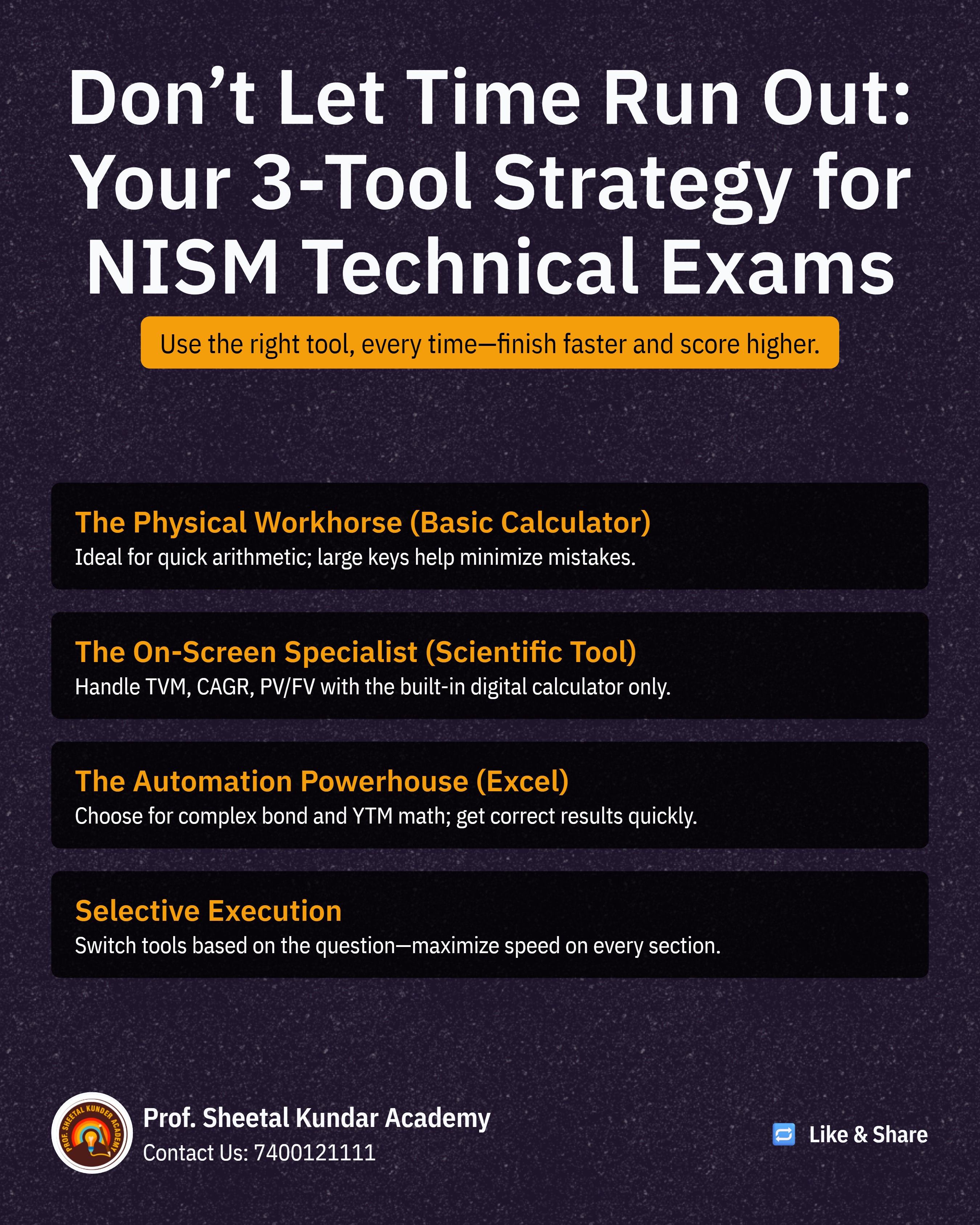

1. The Workhorse: Why You Need a Regular Calculator

A common question is whether a scientific calculator is necessary. The short answer is: No, but a basic calculator is essential.

  • Speed and Accuracy: For the vast majority of questions (around 90-95%)-which involve standard, regular arithmetic calculations-a basic, non-mobile calculator is your best friend.
  • Ergonomics: Its large keys reduce the chances of errors, a critical advantage in a time-bound exam.
  • Practice is Key: You should not wait until exam day to buy one. Start practicing with your designated calculator from the very first day of preparation to develop speed and muscle memory.
  • Avoid Mobile Apps: Never use your mobile phone's calculator for practice, as it will not be allowed in the examination hall.

2. When to Use the Screen-Based Calculator

Scientific calculators are generally not required. For complex computations related to the Time Value of Money (TVM), present value, future value, or CAGR computation, which might require a scientific calculator, you can rely on the on-screen tool provided in the exam interface.

  • No Need to Buy: Do not buy a separate scientific calculator just for the exam.
  • Focus on Speed: Since only one or two such complex questions typically appear, spending too much time on them with a physical scientific calculator can slow down your entire pace. Use the familiar screen-based calculator to quickly compute these values and move on.

3. The Power Tool: Leveraging the Excel Sheet

The ability to use an Excel sheet is a non-negotiable skill for specific types of NISM questions. It is the most efficient way to handle computations that would otherwise consume vast amounts of time.
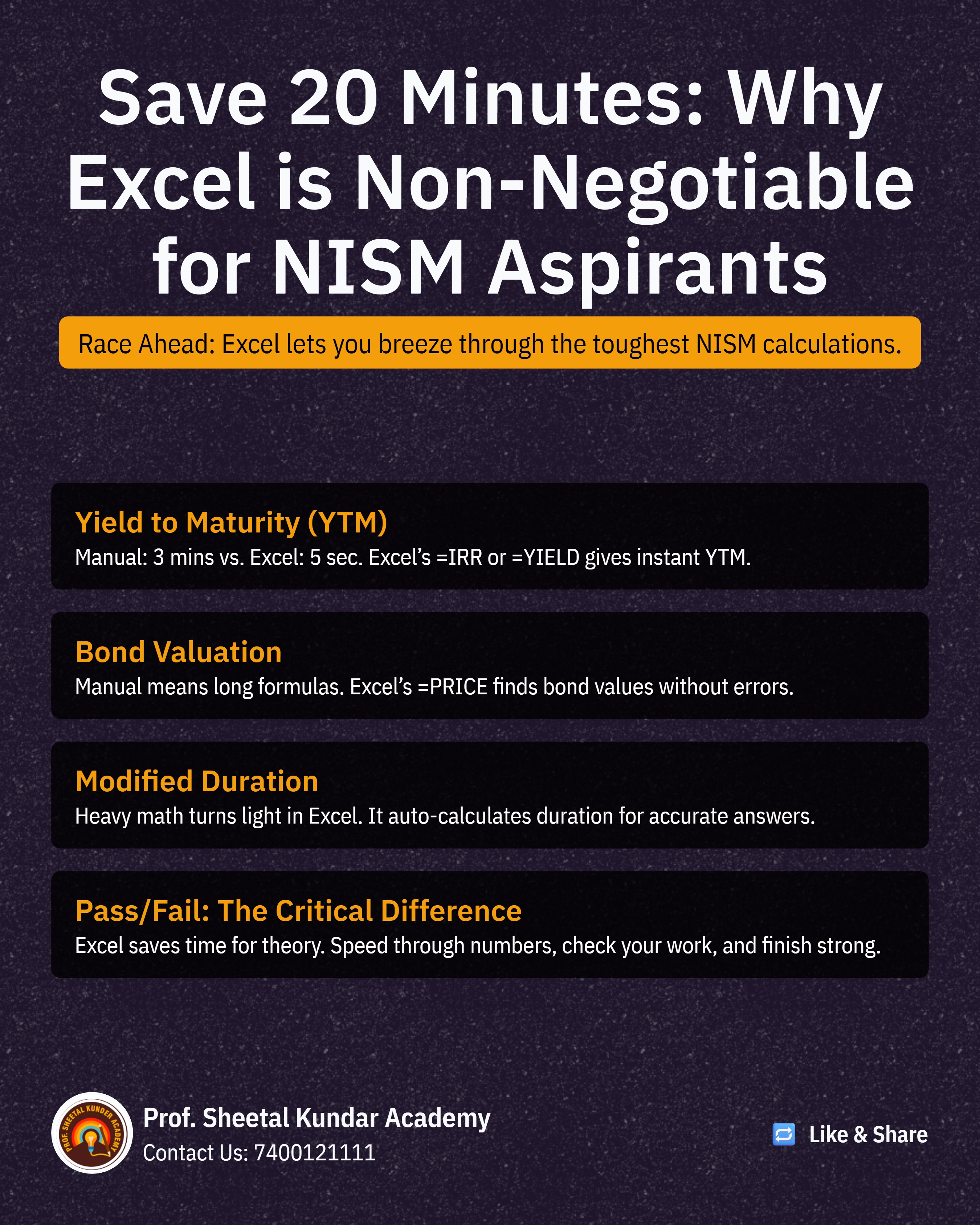
  • Why Excel is Crucial: Attempting to do all calculations manually or relying only on a regular calculator can cause you to miss questions you are comfortable with, resulting in a poor score. Time is highly important for RA and other technical NISM exams.
  • Where to Use Excel: Excel is specifically recommended for questions involving:
    • Bond Valuation: Calculating Bond Price.
    • Yield to Maturity (YTM): Computing YTM.
    • Duration: Computing Modified Duration.
These complex bond-related calculations (common in RA, Fixed Income, and Common Derivatives exams) can be solved using Excel functions in just a few seconds. It is crucial to use Excel selectively-only where it is necessary-to avoid wasting time.


Conclusion: Your Winning Calculator Strategy

To ensure a successful first attempt in your NISM technical exam, commit this strategy to heart:

  1. Regular Calculator: Use for 95% of simple arithmetic calculations.
  2. Screen-Based Calculator: Use for scientific-style calculations like Present Value/Future Value.
  3. Excel Sheet: Use exclusively for complex Fixed Income Securities computations like YTM, Price, and Duration.
By adhering to this plan, you eliminate the risk of missing questions due to a lack of time, ensuring a focused and successful exam experience.


Prof. Sheetal Kunder
SEBI® Research Analyst. Registration No. INH000013800 M.Com, M.Phil, B.Ed, PGDFM, Teaching Diploma (in Accounting & Finance) from Cambridge International Examination, UK. Various NISM Certification Holders. Ex-BSE Institute Faculty. 18 years of extensive experience in Accounting & Finance. Faculty Development Programs and Management Development Programs at the PAN India level to create awareness about the emerging trends in the Indian Capital Market and counsel hundreds of students in career choices in the finance area