There are no items in your cart
Add More
Add More
| Item Details | Price | ||
|---|---|---|---|

{{DATE}}
Defeating the NISM Series 13: Rohit's 4-Step Strategy to Pass the Common Derivatives Exam on the First Attempt.
Thousands of MFDs, AMC employees, and investment advisors take the NISM Series XIII exam every year. A large number of them fail not because the exam is difficult, but because they prepared without a clear sequence or strategy.
NISM Series XIII is a SEBI-mandated certification exam. It qualifies you to distribute derivatives and Specialized Investment Funds (SIF) products in India. This guide walks you through the full exam pattern, topic-wise preparation plan, and exam-day tactics that help candidates clear it on the first attempt. If you are starting your NISM XIII prep today, this is where you begin.
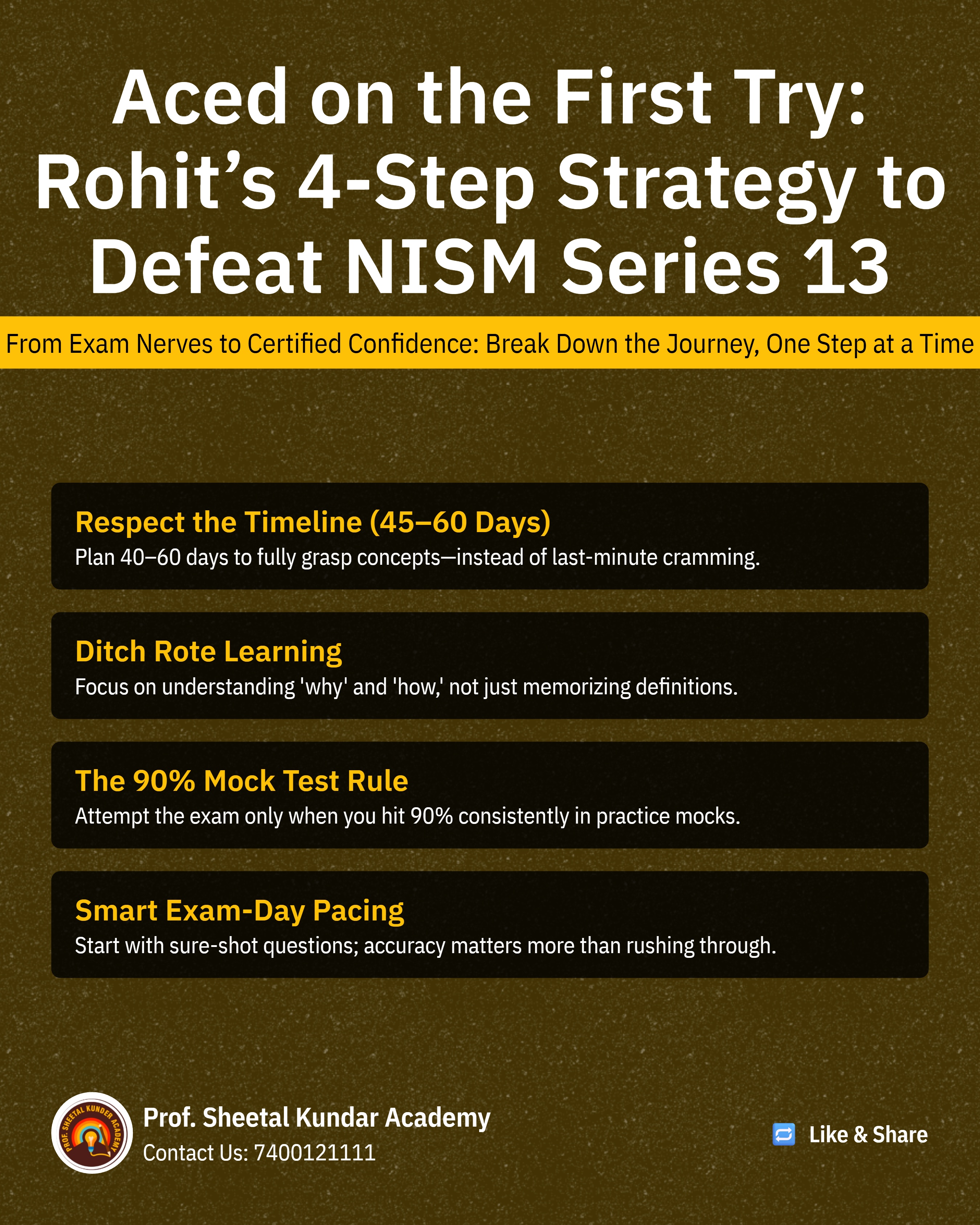
Here is the simple, 4-step plan you need to follow: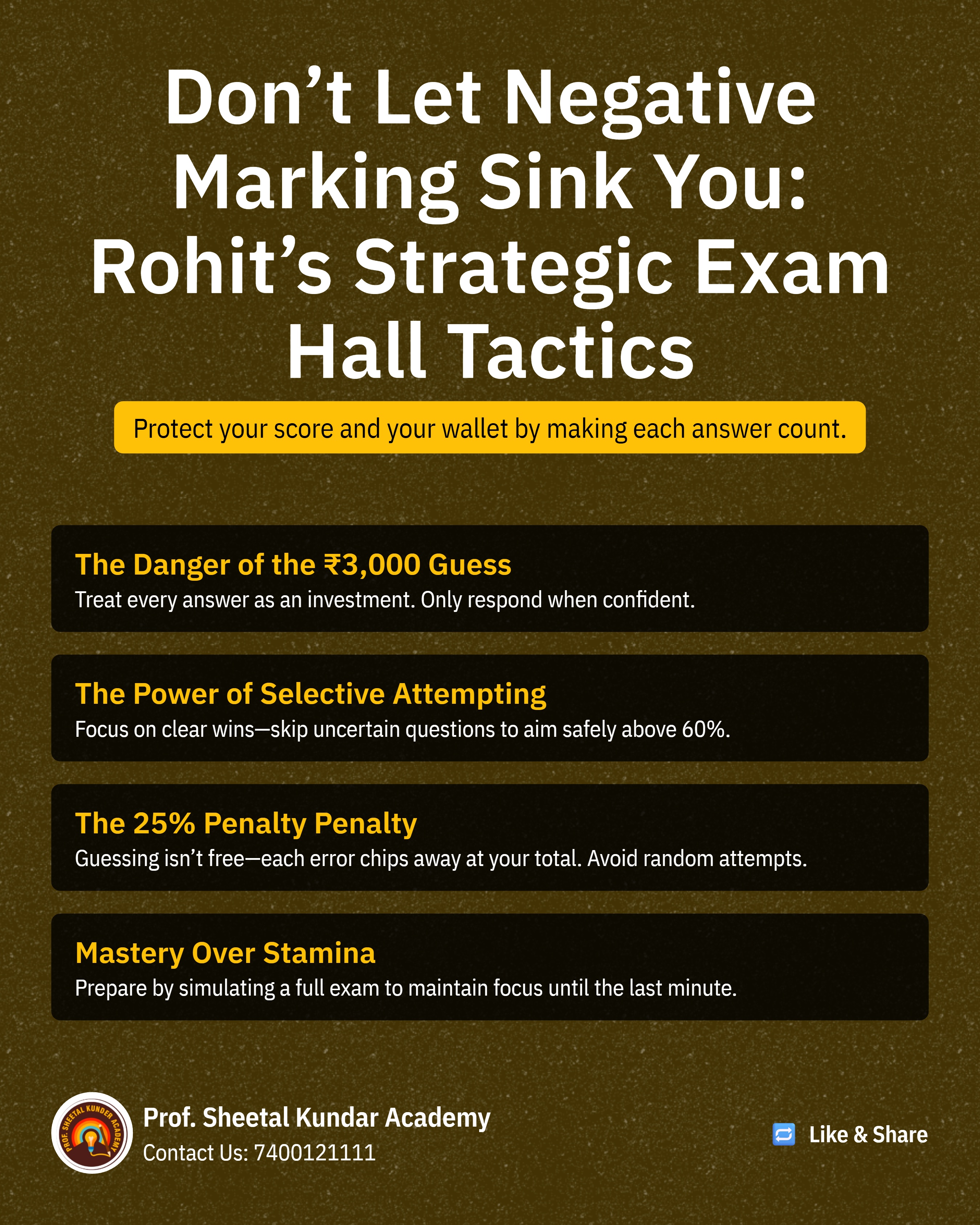
Candidates who clear NISM Series XIII on the first attempt are not necessarily more experienced or more qualified. They simply prepare differently. Three habits separate them from everyone else.
They follow the module sequence without exception. Equity Derivatives first. Currency Derivatives second. Interest Rate Derivatives third. No jumping ahead, no going back mid-module. The NISM XIII syllabus is interconnected - each module builds on the previous one. Studying out of sequence creates knowledge gaps that show up as wrong answers on exam day.
They do not touch mock tests until concepts are complete. Mock tests are a measurement tool, not a learning tool. Candidates who attempt mock tests before finishing the syllabus score poorly, lose confidence, and either cram harder or avoid weak topics entirely. Both responses make the result worse. First-attempt passers use mock tests to confirm readiness, not build it.
They treat Interest Rate Derivatives as the most important module. Most candidates spend the least time on it because it feels the most unfamiliar. First-attempt passers do the opposite. They recognise that this module carries enough question weight to determine the final score, and they prepare it slowly and thoroughly before sitting for the exam.
These three habits require no extra time. They only require a deliberate decision to follow them from day one.
NISM Series XIII is conducted by the National Institute of Securities Markets. It tests your conceptual understanding of equity, currency, and interest rate derivatives, and whether you can explain these instruments to clients without mis-selling.
This is not a trader's exam. It does not test profit strategies, market timing, or technical analysis. It tests whether you understand derivative instruments well enough to serve clients responsibly under SEBI's regulatory framework.
Mutual Fund Distributors (MFDs) handling derivatives-linked products
AMC employees and relationship managers
Investment advisors dealing in structured products
Professionals seeking eligibility for Specialised Investment Funds (SIF) distribution
Approved users and sales personnel of trading members in the Currency Derivatives, Interest Rate Derivatives, and Equity Derivatives segments
Parameter | Details |
Exam Name | NISM-Series-XIII: Common Derivatives Certification Examination |
Also Known As | NISM XIII, NISM Series 13, SIF Exam, SIF Examination NISM |
Total Questions | 150 |
Maximum Marks | 150 (1 mark per question) |
Duration | 180 minutes (3 hours) |
Passing Score | 60% (90 out of 150) |
Negative Marking | 25% per wrong answer |
Certificate Validity | 3 years |
Mode | Online, computer-based |
Exam Fee | Rs. 3,000+ (payment gateway charges extra) |
The NISM Series XIII syllabus covers three derivative segments. Each has a distinct difficulty level and requires a different preparation approach. Treat them as separate modules, not one continuous subject.
This is your foundation. Most aspirants have some prior exposure to equity markets, which makes this module:
Conceptually accessible - builds on stocks, indices, and market direction you already understand
High-scoring - questions follow predictable patterns once fundamentals are clear
The strongest confidence-builder before you face harder sections
Key topics: Futures and options basics, contract specifications, payoff diagrams, margin requirements, hedging strategies, clearing and settlement mechanisms.
Complete this module fully before moving forward. A shaky equity derivatives base makes the next two sections harder than they need to be.
Many candidates dread this section. In practice, it is one of the more scoring parts of the exam.
Questions follow limited numerical patterns with no surprise calculations.
Most questions are conceptual - covering hedging use cases, settlement, and currency risk management.
Focus areas: direct vs. indirect quotation, settlement mechanisms, and how exporters and importers use currency derivatives
Once you understand how currency risk works in trade and portfolio contexts, the question patterns become familiar fast.
This is where most candidates lose marks, and where structured preparation creates the biggest score advantage. The challenges:
Low prior exposure to bond and debt markets among most aspirants
Questions use twisted phrasing around movements in yield, duration, and rate.
Memorisation fails completely - wrong answer options are designed to trap rote learners.
What works:
Understand the inverse relationship between bond prices and yields.
Learn how duration measures interest rate sensitivity.
Understand how RBI policy decisions affect derivative pricing.
Build concept clarity through application, not formula cramming.
Spend more time on this section than on the other two combined.
Why India's Biggest Fund Houses Are Betting Heavily on SIFs Right Now
The speed at which India's fund houses have entered the SIF space is worth noting. When Quant Mutual Fund launched the first SIF in September 2025, there was genuine uncertainty about whether investors would show up at a ₹10 lakh entry point. They did, and what followed was a wave of AMC launches.Within six months, eight fund houses had launched SIFs. Quant came first with its qSIF brand. Edelweiss followed with Altiva. SBI brought in the Magnum brand, ICICI Prudential launched iSIF, Tata launched Titanium, Bandhan launched Arudha, and 360 ONE introduced Dyna. Each AMC gave its SIF a distinct identity, which fund houses do not do for products they consider temporary.The fact that SBI Mutual Fund, India's largest AMC by total assets, placed its SIF under the Magnum brand says a lot. Magnum carries decades of trust among Indian investors. Putting new and relatively complex products under that umbrella is a calculated move that signals SBI's view of SIFs as a long-term business line, not a regulatory checkbox.The AUM trajectory backs this up. The category crossed ₹9,711 crore by February 2026, with monthly inflows jumping 80% from January to February alone. AMCs are not just launching products. They are building brands, hiring specialists, and constructing distribution networks specifically around SIFs.For MFDs, this matters directly. Every AMC entering the SIF space is training its distribution network to push these products. The certified distributors are the ones receiving those conversations. Without NISM Series XIII, you are not part of that pipeline, regardless of how long you have been in the industry.
The Single Biggest Preparation Mistake
Jumping between random YouTube videos. Switching topics without completing them. Taking mock tests before concepts are clear. These habits do not waste time only - they actively build confusion and increase exam anxiety.The NISM XIII syllabus is interconnected by design. Equity derivatives build the logic for currency derivatives. Currency derivatives share settlement mechanics with interest rate instruments. Study it in sequence, or every section will feel like it overlaps without making sense.The correct preparation sequence:
| Phase | Days | Focus |
| Equity Derivatives | Days 1 to 15 | Core concepts + chapter-wise practice |
| Currency Derivatives | Days 16 to 28 | Concepts + settlement mechanics |
| Interest Rate Derivatives | Days 29 to 42 | Slow, thorough concept study |
| Mock Tests + Revision | Days 43 to 50 | Full-length mock tests + weak area revision |
Exam-Day Execution - How to Attempt 150 Questions SmartlyStep-by-Step Attempt Strategy
Why Students Choose Prof Sheetal Kunder Academy for NISM XIII
Most NISM XIII prep resources are either too thin or built around memorisation. PSKA's approach is structured differently:

{{AUTHOR}}
The official exam fee is Rs. 3,000 plus payment gateway charges, as listed on the NISM website.
The exam tests knowledge of the Indian derivatives market, trading and hedging strategies using futures and options, clearing and settlement mechanisms, and the regulatory environment governing exchange-traded derivatives in India.
The exam covers three segments - Equity Derivatives, Currency Derivatives, and Interest Rate Derivatives.
Yes. SEBI has mandated that any entity engaged in the sale or distribution of Specialised Investment Funds (SIF) products must have passed NISM Series XIII Common Derivatives Certification.
25% of the marks assigned to the question are deducted for every wrong answer. If a question carries 1 mark, 0.25 marks are deducted for an incorrect response.
Yes. The passing certificate is issued only to candidates who have furnished or updated their Income Tax Permanent Account Number (PAN) in their registration details.
Yes. The exam tests conceptual knowledge, not trading execution. Candidates from mutual fund distribution, relationship management, and general finance backgrounds clear it regularly with structured preparation.
Interest Rate Derivatives carry conceptually heavy questions. Skipping this section significantly increases the risk of failing to cross the 60% passing threshold, as this section alone can determine whether you pass or fall short.
With structured preparation and consistent mock test scores of 85-90%, most PSKA students clear the exam on the first attempt. Unstructured preparation is the primary reason for second- or third-attempts.
Registrations are done through the official NISM certifications portal at certifications.nism.ac.in.
 Launch your Graphy